1 day
Local anesthesia
Same day
1 day
Local anesthesia
Same day
A single missing tooth isn’t merely an aesthetic issue. It can also lead to shifting of adjacent teeth and resorption of the jawbone. A single tooth implant is a permanent treatment option for replacing a single missing tooth. This treatment fills the gap left by the missing tooth. It also restores chewing and speech functions. Aesthetically, it aims to achieve a natural appearance. Yükleniyor…
Overview


This method is an effective solution for patients who wish to address a single missing tooth without damaging adjacent teeth. However, the treatment’s success depends on factors such as bone structure and oral hygiene. Therefore, it may not be suitable for every patient. Generally, suitable candidates for the procedure include:
Those who don’t want removable dentures: It is ideal for those wanting the comfort of a fixed tooth over temporary, removable options for a single missing tooth.
However, the procedure isn’t suitable for certain cases:
The procedure is a controlled process in which the surgical and prosthetic stages are planned together. The process is completed in several stages, depending on the patient’s bone structure and healing rate. Here is the step-by-step single tooth implant in Turkey: Yükleniyor…
Under local anesthesia, the gum tissue is carefully incised, and the titanium implant is placed into the jawbone. The procedure typically takes 15 to 30 minutes. The implant creates a sturdy foundation that replaces the natural tooth root.
After the implant is placed, the process of osseointegration begins. This process typically takes 2-4 months (in some cases, 3-6 months). During this stage, the implant integrates with the bone and becomes stable.
Once healing is complete, a connecting piece called an abutment is attached to the implant. This piece acts as a bridge between the implant and the crown to be placed on top.
The tooth’s size, color, and shape are determined. A custom crown is prepared using digital or traditional impressions. This stage is crucial for aesthetic harmony.
The prepared artificial tooth is secured onto the abutment. Bite and fit checks are performed. The result is a structure that closely resembles a natural tooth in both appearance and function.
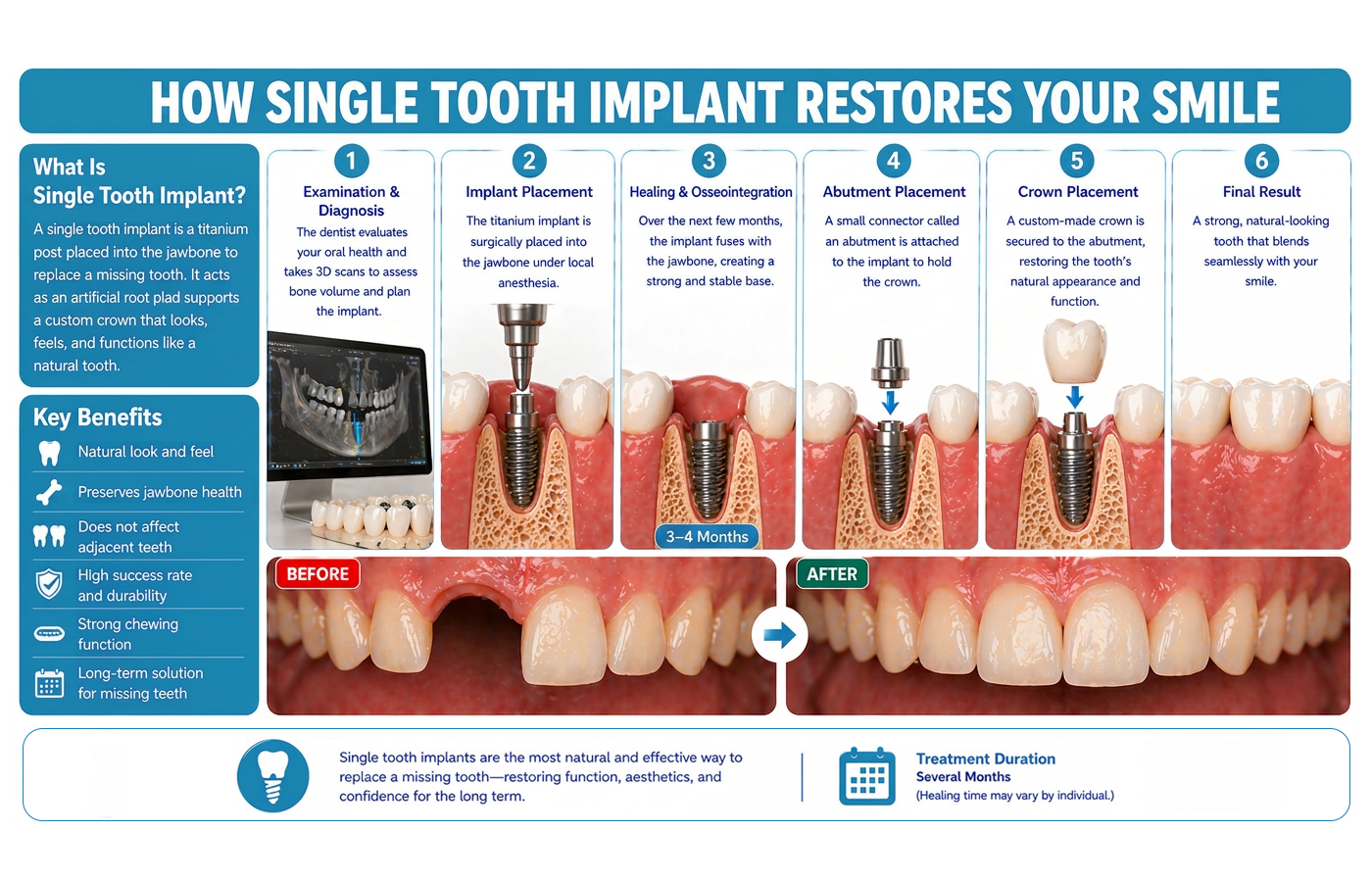

This stage involves the implant fusing with the jawbone. This process typically takes several months. The long-term success of the treatment depends largely on care during this period. With proper habits, the lifespan of the implant can be significantly extended. Take a look at what you need to pay attention to during the recovery process:
Single tooth implant in Turkey is a safe and predictable treatment when properly planned. However, as with any procedure, there are some risks, albeit rare. These risks are generally detected early and can be managed:
After treatment, you’ll feel as though you’ve reunited with your natural tooth rather than having a foreign object in your mouth. The single tooth implant in Turkey transmits chewing force directly to the jawbone, providing the same biting strength as a natural tooth. Thanks to its independent structure, you can floss around your new tooth just like a natural one. This allows you to maintain the highest level of oral hygiene.
From an aesthetic perspective, the crown placed on the implant blends seamlessly with the gum tissue. The point where the tooth meets the gum is never noticeable. The proper shape of the teeth ensures a harmonious, aesthetically pleasing appearance that blends well with the adjacent teeth.
In the long term, this treatment does more than just replace a missing tooth. It preserves your facial symmetry and jaw health. The implant, which functions as a tooth root, prevents bone loss in that area. It prevents lip and cheek sagging, thereby preventing the face from appearing aged.
A single tooth implant is a dental solution that consists of an artificial root placed in the jawbone to replace a missing tooth, along with a crown attached to it.
A single tooth implant is ideal for restoring a missing tooth without compromising adjacent teeth.
Thanks to local anesthesia, no pain is felt during the procedure. Any mild discomfort afterward can be managed with standard pain relievers.
The placement of the implant takes a single day. However, a 3-6 month waiting period is required for osseointegration.
Yes. With proper planning and the right crown, a single implant looks virtually identical to a natural tooth.
Single-tooth implants typically last 20 years or longer. With proper care and regular checkups, many implants can last a lifetime.
He has been working at Diş 212 Clinics since 2011 and is a founding partner. Implant applications; Implant prostheses, aesthetic applications and smile design are his areas of special interest. He speaks advanced English. He is a member of Turkish Dentists Association (TDP), Aesthetic Dentistry Academy Association (EDAD), Kalkedon Dentistry Workshop.
Medically reviewed by
Dt. Aykut Koşun, MSc
Published
April 30, 2026
Last medically reviewed on
July 4, 2026
Implant & Cosmetic Dentistry



We provide structured, patient-focused dental care across general, cosmetic, and specialist treatments.
EURO BANK ACCOUNT INFORMATION
NAME: AK 212 BAYRAMPAŞA DİŞ SAĞLIĞI HİZM.
IBAN: TR17 0006 2000 7360 0009 0780 69
SWIFT: TGBATRIS736


Last Update: July 4, 2026
Content Editor: Veysel Koyuncu, Email: kcveysel97@gmail.com
Telephone: +90 549 430 40 64
Copyright © 2026 All Rights Reserved. Digital Solutions by Digiduction

How can we help you?
Fill out the form below and our team will get back to you shortly.
Your request has been sent successfully.
Our team will contact you as soon as possible.